
A TASTE OF FIVE – RACHEL SIGNER
28/08/2026
06/05/2026
A conversation about femininity remains a delicate undertaking. Although broader feminism has made many issues discussable, for a wider audience it is more often known as “the women’s problem.” Does that settle the matter? In light of the future, a male artist, Johan Grimonprez, and a woman curator, Jamain Brigitha, believe that femininity, especially now, can create a comprehensive shift, both in the arts and in society.
– Eva Peeters and Tom Viaene
Founder of The Caribbean Housewife Jamain Brigitha has worked with intersectional feminism, representation, spirituality, art, and society for 25 years through exhibitions, site-specific art projects, symposia, articles, and cultural programs. Her focus on women-led projects is far from a trend. It comes from her university education and has been part of her work for years. The role and position of women in society remain a recurring thread through everything she creates.
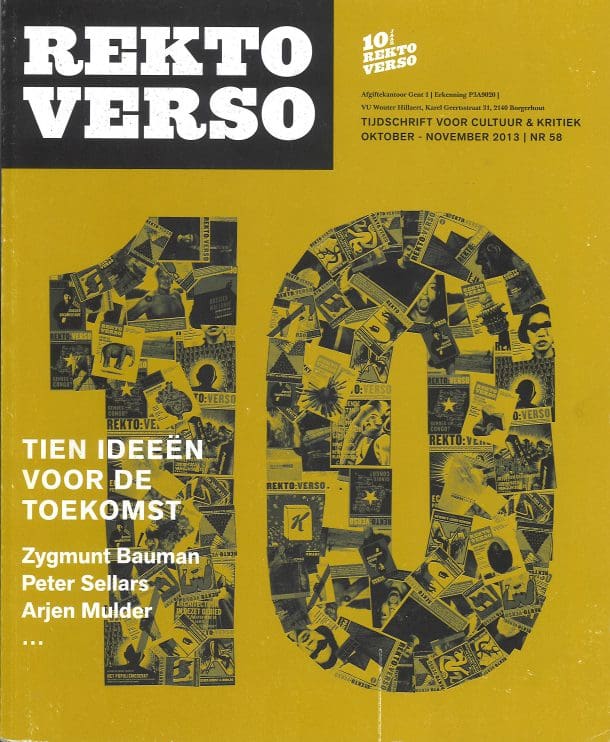
Below is a highlighted example and English translation of an article published on September 25, 2013 in Belgian magazine rekto:verso. It is a conversation between Jamain Brigitha and Johan Grimonprez. In our current time where aspects such as feminism, femininity, masculinity, the manosphere, gender, violence, corruption, and warfare are highly visible, it feels striking how much of this article still resonates.
A conversation from 2013 on femininity, art, spirituality, and the role of women in society. Still relevant today.
He, internationally renowned, made films such as Double Take (2009) and dial H-I-S-T-O-R-Y (1997). She, founder of the Dream Amsterdam Foundation, realised her “girlhood dream” last year with the varied, multidisciplinary program Girl, you’ll be a woman soon. In it, she stimulated, among other things through a symposium, the search for the essence of the woman in 2012.
“That program was partly based on Simone de Beauvoir: you are not born a woman, you become one. It wasn’t so much about the appealing image of the painting, but about how you develop into a woman and what you need for that.”
She tackles the question of “femininity” directly. He sees it as a subtheme of a larger issue that occupies him in all his activities: how global society is fundamentally changing. He speaks about the need for a redefinition of a “we.” She points to the lack of spirituality within the arts. She wants to strengthen the connection between the spiritual and the arts. He sees an inseparable relationship between art and a broader reality, both on a societal level and on an intimate level.
“I think you cannot separate those two. It is precisely because the man has a completely distorted image that he thinks: ‘we must remain strong, our society must be strong, we must stimulate our defense industry,’ and so on.”
His critique of the social absolutisation of one emotion (conflict), and her call for more inspiration (and less theory), will continuously intersect in this conversation. There is, however, one issue that immediately “binds” them. It is a question that, according to them, is still addressed too little: where are “we,” all of us together, heading?
Both share the conviction that everything is interconnected. Their perspective is therefore not only directed at the art world. Strong is their urge to see connections between what goes “wrong” in art and in the world.
“Femininity” can also be understood more broadly than simply being a woman. The concept has undergone a whole evolution over the past thirty years. Some even go so far as to say that a “feminisation” of society has taken place.
It is difficult to deny that three “feminine” values that have strongly emerged over the past fifty years, partly under the influence of three feminist waves, have in many cases already been recuperated by the social system. In the arts as well, these values have gained ground.
The first value, “sharing,” can be found in the growing number of artistic projects around “community” and “care.” The second value is related to the return to (the visualization of) affects and emotions after conceptualism. And the third value, “inclusion” and “participation,” has even penetrated arts policy.
We fall into platitudes when we talk about women: motherhood, menstruation, or even “standing on the barricades against men.”
It seems that we can now understand femininity more broadly than in terms of a separate (female) art history. The strategy of “separatism” – resolving unequal relations by placing the woman on a separate pedestal – is no longer relevant. A number of seemingly favorable developments in the field, such as the fact that more and more women play an important role in the international curatorial world, seem to confirm that we are now living in a post-feminist era. And although not everyone agrees with that, a broader perspective on femininity is possible. It is from that future perspective that we engage in a conversation with “her” and “him.”
There are many misunderstandings and shallow stories about feminism, not to mention the “internal” division between the second (1950–1980) and the third wave (since 1990) within feminism. Has “femininity” not suffered from all this?
Jamain Brigitha: “Certainly, a number of persistent assumptions make the investigation of femininity more difficult. One, we think we know what a woman is. Two, we assume that this subject has already received sufficient attention and has little new to offer. Three, we more often fall into platitudes when we do talk about women: motherhood, menstruation, or even ‘standing on the barricades against men.’
‘Femininity’ is such a multi-layered concept that all attempts to fix its meaning result in the denial of so many other facets of the woman. Still, we should not be afraid to distinguish a feminine force or feminine values. Critics have rightly pointed out the danger of essentialism in this regard, but they have subsequently failed to stimulate a broader exploration of femininity as such.”
Is every attempt to distinguish the woman not somewhat outdated, now that many assume that the (women’s) struggle has been fought? Also in the arts, there is a post-feminist conviction that the inclusion of women is now a “fact.”
Jamain Brigitha: “Even if that were true – and I doubt it – that still does not mean that we should not remain vigilant for distorted or limiting definitions of what a woman can be. One of the beautiful things that was said when feminism emerged in the arts was that it formed a break with modernism, which was predominantly dominated by men.
Of Picasso it was said that he liked to cut women up. In that way, a ‘distorted image’ of women was presented. Is that outdated? It may be very difficult to define the woman, but we must consistently strive for a clearer picture of the systems in which the woman is positioned. How does she function within them? How do women and men relate to each other?
We must also dare to talk about the role that a woman wants to fulfill within that. Essentialism or not, a woman can simply multitask much better than a man. She can have a child, take that child on her chest, at the same time run a household, make phone calls, …”
Johan Grimonprez: “Saying that something is typically feminine carries the danger that you turn biology into determinism. While everything is constantly in motion: if, over several generations, you redefine the relationship between man and woman, that also translates into biology. You cannot simply ignore the history of how we have defined ourselves. You are born into a world with specific power structures that are a reflection of our self-definitions.”
Jamain Brigitha: “Biology does not have to be deterministic, no. But those differences between men and women do play a role in relationships. A lot of conflicts have to do with those kinds of things. My point is that the woman may be more versatile than the man. Purely because we can do one thing ‘more,’ and that is to have children. A woman is a creator. Femininity stands for creation. And that can be about more than just children.”
Is “masculinity” not just as dynamic now that equality between the sexes has become the norm? Should we not understand the polarity between masculinity and femininity differently?
Jamain Brigitha: “That’s true, but the difficult thing is that things are going reasonably well for men, while women still feel disadvantaged. At the same time, it is not about equality, as Germaine Greer also indicated: ‘Equality is such a silly thing to want to achieve.’ As man and woman we all have our specific roles. Only you are not supposed to say that, because many critics consider it not done to classify men and women in a certain way. Nevertheless, you can assume that the existing polarity between the sexes is intended for reproduction and sexuality.”
From the moment that “conflict” was seen as something positive – it sells weapons, it keeps society strong – the man also started to go off the rails.
Johan Grimonprez: “It can also be about cooperation, about interaction. If the woman redefines herself, then the man changes as well, and vice versa. In addition, I am not so sure that things are going well for the man. A lot of pain and traumas are suppressed. The dominance of a certain patriarchy means that not only the woman, but also the man is not in balance.
And I believe that ‘war’ is the key here. From the moment that ‘conflict’ was seen as something positive – it sells weapons, it keeps society strong – the man also started to go off the rails. I have to think of two men I interviewed for my new film Shadow World (released in 2016: see below). Chris Hedges was for twenty years a war correspondent for The New York Times and was fired because he spoke out against the war in Iraq. Ricardo Privatera is an arms dealer who once, as part of Special Forces under the South African apartheid regime, had to go and murder ANC members. Both of them talk at length about what they experienced in war, until they both run into their trauma. Privatera cries at the end. Hedges loses his restraint and speaks openly about trauma, pain, and ultimately about love. If the trauma sits that deep, you can no longer feel. That is essential.
Experiments have shown that rats confronted with a death trauma start occupying themselves with trivialities. That is where ‘we’ are. The trauma around ‘our’ world that we are in danger of losing is so great that we, men and women, fall back on ourselves and occupy ourselves with trivialities.
‘Equality’ especially means: men and women who can look each other in the eye. From that surrender, that difficult ‘loss of self,’ and therefore dialogue, new possibilities arise.”
A great deal of oppression, inequality, and communication breakdown stems from a poor, one-sided image of the human being?
Johan Grimonprez: “I believe so, yes. From the interviews for our film about corruption in the global arms trade, it becomes clear once again that most people assume the cliché image that the human being is a warrior, that there has always been war, that we are all subject to ‘the law of the strongest.’
But is that really the case? That social Darwinism on which Reagan-Thatcherism in the 1980s was based: is that the lesson we learned from Darwin? No, that ‘law of the fittest’ turns out to be an interpretation by someone called Herbert Spencer and is now strongly contested.
The primatologist Frans de Waal, who writes about empathy based on research with bonobos, completely dismantles that competitive way of thinking. One of the first needs of newborn babies is empathy. In order to survive, we need to be held.
At this moment, competition is the driving force of our society, our economy, even our culture. That is why we are in such a fiasco.”
Can art still mean something for that paradigm shift you have in mind?
Jamain Brigitha: “I continue to believe it can. As a curator I search for those artists who are engaged with this theme. But I do find myself in a difficult position: between the serious, theoretical curators and the more light, kunsthalle-type curators. I constantly try to navigate between the two: I show both more rational work and also allow space for spiritual aspects.
I think we need to explore the spiritual much more: we are all one, connected to each other like trees in a forest that breathe together. Art can still make us more aware of this: if you do something on the left side of the planet, it is also felt on the right side. And what applies to the plastic on the seabed also applies to femininity.
If you see how the media and advertising portray women as objects, then that must directly damage how girls grow up and think they should be as women. As Germaine Greer also stated during the symposium we organized with Dream Amsterdam: it has never been so bad that women or girls do not know what a woman is. We are part of a kind of caricature: we are either super sexy or a hardworking woman or a stewardess, but we are never a whole woman. Art can form an important counterweight to those stereotypical images in advertising.”
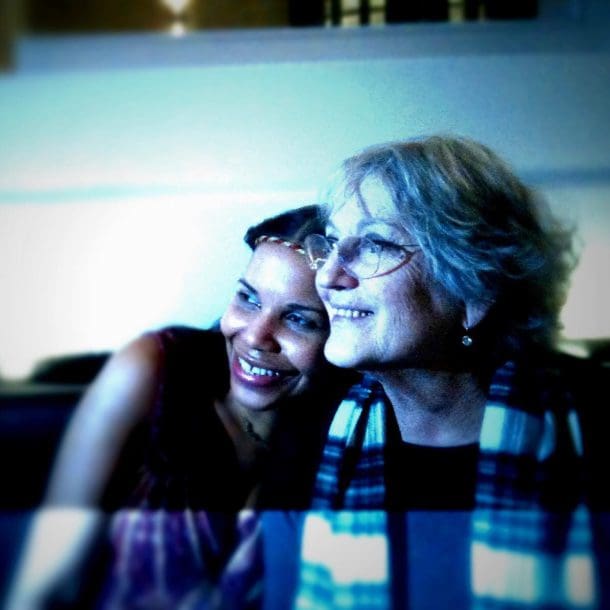
Jamain Brigitha and Germaine Greer
Symposium Girl, You’ll Be A Woman Soon (Amsterdam, the Netherlands 2012)
– Photo Iris Zoric
A creativity that departs from cooperation and dares to question the current conflict paradigm, that is what is needed!
Johan Grimonprez: “That hope for a counterweight does not need to be placed exclusively in art. I would rather emphasize the importance of creativity. There is such a fundamental lack of thinking playfully and together about things.
Of course, the artist is someone who, with a specific creativity, manages to place things in a different light. But if we place that responsibility only in the sometimes narrow world of art, then we contribute to a narrowing.
I try to keep my own practice as diverse as possible. For example, I also teach about Radical Ecology and Tender Gardening to art students in New York. That is not only about art, but also about permaculture, genetically modified food, time banking, alternative energies, biopiracy, biotecture, architecture.
Those students then come up with all kinds of interesting experiments and alternatives, and each time such a dialogue results in the realization that a paradigm shift is needed in society in how we define a ‘we.’”
With your own work, among other things with Double Take, you have nevertheless contributed to a strong counterweight against those mechanisms of the media that Jamain referred to.
Johan Grimonprez: “In Double Take I indeed play with the famous commercial break of Folger’s coffee and suggest a connection with the politically staged Kitchen Debate between Nixon and Khrushchev in a kitchen in the Soviet Union in 1959.
While those two heads of state ‘debate’ about missiles, I let the woman from that commercial intervene with: ‘okay, we have washing machines too.’ In this way, that paternalistic kitchen debate on the political world stage, where the woman has no place, is mirrored in that private kitchen of the Folger’s commercial, where the woman derives her right to exist from making coffee.
What is interesting is that there is a direct link between the relations between men and women in the media and advertising, and the attitude of society toward the household, and more broadly, the economy. Look at the entire advertising history of Swanson’s TV dinners and you see how the media, over the decades, have shaped the ideal (consumer) family. Even the emancipation that emerged in the 1960s was immediately incorporated into a sales tactic.”
Jamain Brigitha: “Commercials are made by companies that lull people to sleep. We are presented as consuming robots. And femininity is not only often reshaped and reduced, it is also used to justify all kinds of things and to sell better.
No one illustrates that better than Hillary Clinton. It is disturbing how the majority of people no longer see the broader connections behind such a figure of power. If a woman reaches a high position, does that automatically mean she is good for society? Will she therefore be a better emancipator?
From false Darwinist ideas, we openly misuse female roles in politics and society.
Johan Grimonprez: “Sometimes I do notice that children are not entirely passive in this. I see that with my own daughter: there is always a kind of humor and iconoclasm that allows them to create some distance from the advertisements that threaten to overwhelm them. ‘Men know why’ then simply becomes, in the back seat of the car: ‘Yes, but women know why too!’
On the other hand, the media like to give the impression that no one is still engaged with alternatives. Yet that community of ‘creatives’ is larger and more widely spread than we sometimes think. They are not heard in the mainstream media, and even in social media they are often pushed aside.
Nevertheless, those small, local communities that experiment with new ways of living together, a new ‘we,’ form a ‘simple’ answer from ‘ordinary’ people to the crisis. Often there is also a link with the art world.”
Should we be afraid of art that explicitly expresses certain values?
Johan Grimonprez: “Afraid? What should we be afraid of? We are bombarded by an entire industry of fear that ensures that we withdraw into ourselves, that we can no longer open up, can no longer be generous.
In the past we were ‘happy consumers,’ now we are ‘consumers of fear.’ In the past, capitalism established itself in a country by first stabilizing it. Now it does so by destabilizing: by creating conflicts in order to accumulate capital through that industry of fear.”
So you put forward “cooperation”?
Johan Grimonprez: “If we want to rethink the economy, cooperation is necessary. Think, for example, of the thesis of Bernard Lietaer that we can also approach the economy from a perspective other than ‘profit’ and ‘self-interest.’
Or think of alternative experiments such as time banking: that does not work without agreements on how you build and exchange things together. In any case, it remains important not only to expose problems, but also to point toward alternatives.
When making our new film The Shadow World, writer Andrew Feinstein, producer Joslyn Barnes, and I encountered the work of philosopher Judith Butler. Within the whole question of ‘just wars,’ she indicates that we do not have to choose between violence and non-violence, but that we can immediately embrace another paradigm: choosing for (vulnerable) life itself.
That made us realise that we do not only want to expose the corruption of the arms trade, but also want to formulate a way out.”
Jamain Brigitha: “To what extent can art still be sufficiently engaged? And especially: to what extent are there still artists who can do that, or curators who want to pay attention to it in major exhibitions?
If you look at the market mechanisms at play at the many fancy art fairs, Art Basel, Miami, then it does not look good. Fortunately, there are indeed enough exceptions. Especially in the field of social design, a lot is happening.
Think of Pedro Reyes: a Mexican artist who made musical instruments from the pile of weapons he received from the authorities. In another humorous project, he stages therapies in a sanatorium. There, fittingly, questions are asked such as: ‘What kind of fruit are you, and what kind of fruit is your partner?’ And then it turns out he or she is, for example, an orange, from which Reyes then makes a shake. Such basic things create space to think differently.”
Is femininity the key to bringing about change?
Johan Grimonprez: “For me it is not about redefining what a woman or a man is. Much more relevant is being in dialogue: ‘how do you feel as a woman or as a man, and how does that feel for the other?’
The pain that exists between men and women is an old social pain. And so we must move toward the perspective of a ‘new we.’ A ‘we’ immediately allows for dialogue. But because of that pain, we hardly dare to think about it.
I think that is the crux of the problem: we do not dare to go beyond our own limited self. Shielding the ‘self’ leads nowhere. You must always be able to relate yourself to the greater whole.
The constant fueling of that industry of fear, and the focus on war and war language, ensure that we do not develop a broader vision of the relationship between the self and society.”
The struggle for values such as sharing, caring, and nurturing is hopeless if we do not pay attention to the systems in which the woman is positioned.
Jamain Brigitha: “It is about that view of society as a whole, yes. That is precisely what has always connected the different strands within feminism: the struggle for justice and equality. The emphasis on the feminine as such is not so interesting. It is always about a broader engagement.
Thus, the struggle for values such as sharing, caring, and nurturing is hopeless if we do not pay attention to the systems in which the woman is positioned.
If you look specifically at the relationship between man and woman, it is important to determine what you focus on. Social aspects? Career? Spirituality or emotions? There are so many ways to look at being a man or a woman. And for me, that is more a spiritual question than a social or art-critical one.”
Does such a spiritual turn not make the analysis elusive?
Jamain Brigitha: “Why? When you talk about women and femininity, you are often seen as a hippie. But in California, for example, ‘the woman,’ what they call the return of the goddess, is a very important subject.
And I think that we are also increasingly recognizing the importance of that theme here in the West: the rediscovery of femininity, both in men and in women. That movement, the return of the goddess, views the woman much more from strength than from weakness.
Women are increasingly realizing that their femininity contains enormous power, instead of reducing them to weak beings. That power lies both in creation and in care for society. But that power also contributes to harmony: if things go well for the woman, they go well for the man.”
Contemporary art seems to have little affinity with “spiritual forces.
Jamain Brigitha: “The spiritual is not taken seriously there, that is true. And that has little to do with masculine or feminine: in art it apparently has to be about context and concept, about very complicated formulas. Reason prevails: art is completely over-theorized.”
In art, everything seems to revolve around context and concept, around highly complex formulas. Art has been completely over-theorized.
Johan Grimonprez: “Of course, this is not only a problem of the art world. Our world is dominated by a very narrow conception of reality. And the community is a reflection of how we deal spiritually with each other and with the world: what brings us together?
We lose ourselves in the external, the material. And we look down on the inner and on what connects us. The sense of togetherness, both within the community and between the inner and the outer, is far away.”
Sometimes you get the impression that when female artists take “femininity” as their subject, they are more easily dismissed. It would be interesting if a male artist worked around masculinity or femininity.
Jamain Brigitha: “Yes, exactly. An artist like Jesper Just not only looks at women and femininity, but also at transsexuality as a man. He does that in a very particular way. He is not a voyeur, he simply shows the woman as she is, how she moves, what she does.
That was exactly what I aimed for with Girl, you’ll be a woman soon: to show the different possibilities of becoming a woman, also in relation to my own history. Women are mainly taught what they should not do: ‘keep your legs closed,’ ‘don’t sleep with someone on the first night,’ and so on.
It is never about: ‘you have a strong feminine power, and you can use it to manifest things.’ That has always been suppressed, just think of the witch hunts.
Also My Bed by Tracy Emin is a beautiful example of artistic work that not only takes her own ‘femininity’ as a theme, but also shows that her own research has evolved along with the changes in her life as a woman.

My Bed by Tracey Emin (United Kingdom, 1998), DACS 2026.
Courtesy The Saatchi Gallery, London.
– Photo by Prudence Cuming (Associates Ltd)
Her bed installation with tampons is a mess. She recently said in an interview: ‘If I look at that now, I would never be able to make it again. But that is what I was dealing with at the time.’
She was very focused on her sexuality, in relation to norms and values that did not accept it. She went through all of that, and now she says: I no longer have sex, I no longer have relationships, I am now an older woman and I am trying to love myself, that is already difficult enough.
And then you reach a certain age at which you are forgotten as an ‘older’ woman. That is exactly what Emin’s work shows, that she has gone through all of that. Artists with similar projects and impressive oeuvres are Cindy Sherman, Martha Rosler, and Jenny Holzer.”
Where would you like to be in ten years?
Johan Grimonprez: “I want to continue building sustainability from the ground up. I am currently involved in a transition group on the Greek island of Andros, where I live part of the time. I want to see such initiatives grow further. I do not believe that major solutions will come from above, but that they will grow out of those kinds of complementary practices, and from an inner stillness in order to reconnect. There will of course always be my artistic projects, such as two films in the near future. The film that emerges from the vlog On Radical Ecology and Tender Gardening is illustrative of my way of working. Instead of focusing on what we do not want, that film asks the often-forgotten question: what do we want?
In that way we encounter a different approach to food, small-scale agriculture, new energy models and economic models, other forms of education. But for those new meanings to grow, for that paradigm shift to take hold, the power structures within society must also change. And that cannot happen without deep dialogue, also between men and women.”
Major solutions will not come from above, but will grow from complementary practices, and from an inner stillness in order to reconnect.
Jamain Brigitha: “I also want to continue making those connections with society, but then from within the arts themselves. In doing so, philosophers, scientists, architects, and filmmakers are always involved. In the end, all those perspectives tell a similar story. And I want people who see my projects or participate in them to also work with that content in other ways.
For example, since 2008 I have been working on a project about Los Angeles: Dream LA. In it I focus on urban planning. LA is a city governed by the car, partly thanks to General Motors. GM literally bought up all the trams, set them on fire, and then built highways. That infrastructure largely determines how you move through LA. A world of difference compared to Amsterdam, where you cycle to the Vondelpark. And in that way, in ten years’ time, I want to have done as much as possible in different world cities to offer that reflection on the world around us from within the arts.
Hopefully all those projects will then read as one large trajectory toward a certain goal, like with Tracy Emin. We will see. The only thing I know is that my work focuses on awareness and wonder, on showing and searching for who we are, where we stand, and how we live.”
Main Photo
Installation My Bed – Tracey Emin (United Kingdom, 1998)
by Sonal-Bakrania at the Tate Modern Retrospective A Second Life (United Kingdom, 2026)