Different Islands, Different Trajectories
This is where the non-monolith story becomes visible. The Levantine presence developed differently in each territory, shaped by local political conditions, economic structures, and existing social composition.
In Haiti, the record is the most dramatic. Lebanese immigrants began arriving in the 1880s, initially welcomed as traders. By the early 1900s, resentment from established merchant groups and political actors had turned into direct state action. In 1905, the government ordered all Syrian traders, without exception, to close their shops. Violence accompanied the pressure, with attacks on Syrian establishments carried out openly. In 1911, the newly elected president went further, banning Syrians from setting up enterprises in the country, cancelling their trading licenses, and giving them six months to cease all commercial activity. Many families left. Those who remained continued to operate under changed and uncertain conditions.
The story did not end there. During the US occupation from 1915 to 1934, Lebanese and Syrian entrepreneurs who had stayed became local agents of American commercial interests, which rebuilt their economic position. By the late twentieth century, Syrian-Lebanese families had become part of Haiti’s financial elite. In 2021, following the assassination of President
Jovenel Moïse, gang leader
Jimmy Chérizier publicly called for violence against business owners of Lebanese and Syrian descent and urged them to leave the country. A 2022 US State Department report documented ethnic discrimination against this community. The tension that began in the early twentieth century has never fully resolved.
In the Dominican Republic, the trajectory developed differently. Lebanese families established themselves in business through the early and mid twentieth century and later moved into public life.
Luis Abinader, whose grandfather emigrated from Lebanon in 1898, became president in 2020 and was re-elected in 2024. He is the second president of Lebanese descent in the Dominican Republic, a detail that points to how thoroughly Levantine families integrated into the country’s political and economic structures across generations.
In Curaçao, the Lebanese presence reached into the highest levels of government.
Emily de Jongh-Elhage, of Dutch-Lebanese descent, served as the 27th and final Prime Minister of the Netherlands Antilles from 2006 until the territory’s dissolution in 2010. Her family name carries the layering that defines Curaçao itself, where Lebanese trading families built cross-border networks connected to Venezuela and the wider circum-Caribbean region across more than a century of commerce.
In Jamaica and Trinidad and Tobago, the presence became part of ongoing public conversation. Discussions about business ownership, price competition, and economic influence appeared in the early twentieth century and have continued in different forms into the present. The language changes, but the subject remains recognisable. In Suriname and Guyana, communities remained smaller and stayed closer to local markets.
Trade, Visibility, and Tension
Across the region, their position carried tension from early on. Trade placed them at the centre of everyday exchange. That visibility came with scrutiny. In the early decades of the twentieth century, Levantine merchants were often described as outsiders in newspapers, public debates, and colonial records, even after years of residence. Several territories introduced licensing systems and commercial restrictions that affected foreign traders directly.
Family-based business networks were central to how these communities operated. Relatives financed each other, supplied goods, and expanded across locations. This was practical and common across diaspora trade. At the same time, it shaped how others perceived them. Complaints about price competition and control of certain retail sectors appeared in multiple territories, especially during economic downturns in the 1920s and 1930s and again in later periods of crisis.
Generations grew up within this structure. Language shifted, identities expanded, and family histories carried both Caribbean and Levantine references.
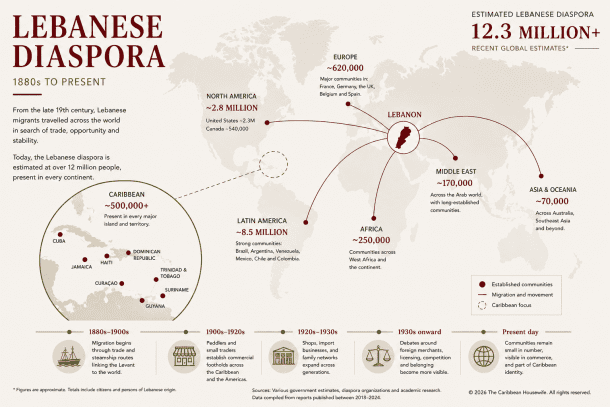
Map showing the Lebanese diaspora from the 1880s to present
For families living between departure and belonging, food became one of the places where memory and rituals could remain whole. Cherished ingredients held what was left behind. Garlic, citrus, herbs, oil, peppers, vinegar. Fresh bases prepared before cooking. In Haiti,
Epis is blended and used to build flavour from the start. Dishes such as
Griot are prepared with citrus and garlic and served with
Pikliz. The plate carries richness, acidity, heat, and freshness together.
Cooking over fire, marinating ahead of time, eating in groups, letting flavour develop before and during the meal. These practices have accumulated across generations, shaped by multiple hands and multiple histories. This is the space we work in.
Resources
Exceptional Caribbean
Jamaicans.com
New Arab
Jamaica Gleaner
Nalis
Lebanese in the Caribbean
The Lebanese Diaspora – Dalia Abdelhady
Lebanese Diaspora
The Dream Variation
Haitian History
Know Your Caribbean
Photo
The Caribbean Housewife x Heya Wines
Agnes Saaby Thomsen
